Study objectives
Study objectives are study endpoints from the user perspective. A study objective corresponds to an expected output for the user. In pyaesa, five study objectives are currently available:
Study objective |
Corresponding output for the user |
|---|---|
|
Life-cycle assessment (LCA/IO-LCA) |
|
Dynamic carrying capacity (CC) |
|
Allocated share of carrying capacities (aSoCC) |
|
Allocated carrying capacities (aCC) |
|
Absolute sustainability ratio (ASR) |
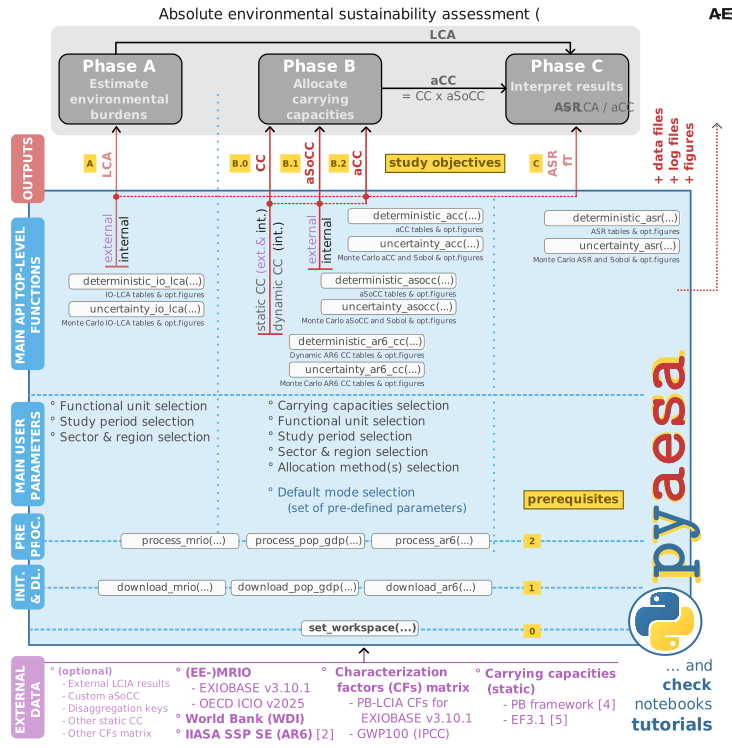
pyaesa automatically orchestrates functions to reach study objectives
It is very important for the user to understand that to reach a desired study objective, pyaesa automatically orchestrates the call of relevant functions to reach the desired endpoint. This means that pyaesa automatically runs upstream computations needed to produce that endpoint, i.e., to ensure that all previous outputs are available before running the downstream function providing the endpoint. The user hence only needs to focus on what is the study objective of interest, and run the relevant function.
For instance:
For B.2 study objectives (i.e., aCC endpoints), the final entry function can auto run pyaesa owned deterministic aSoCC and dynamic AR6 CC outputs when needed.
For C study objectives (i.e., ASR endpoints) with pyaesa owned IO-LCA, the final entry function can auto run pyaesa owned aCC and IO-LCA outputs when needed.
For ASR with external aSoCC or external LCA,
prepare_external_inputs(...)creates the external input folders, and users must stage the external files before the ASR call.
Choose the study objective (i.e., the endpoint) and call the corresponding deterministic or uncertainty function directly.\
What to do next
Check out tutorials/study_objectives/1_functional_units_and_allocation_methods.md before discovering the notebooks provided for each study objective available in pyaesa.