Package Overview
Beta status: pyaesa is currently in beta testing. Please report bugs, unexpected behavior, documentation gaps, and installation or workflow issues on the GitHub Issues page.
Package Scope
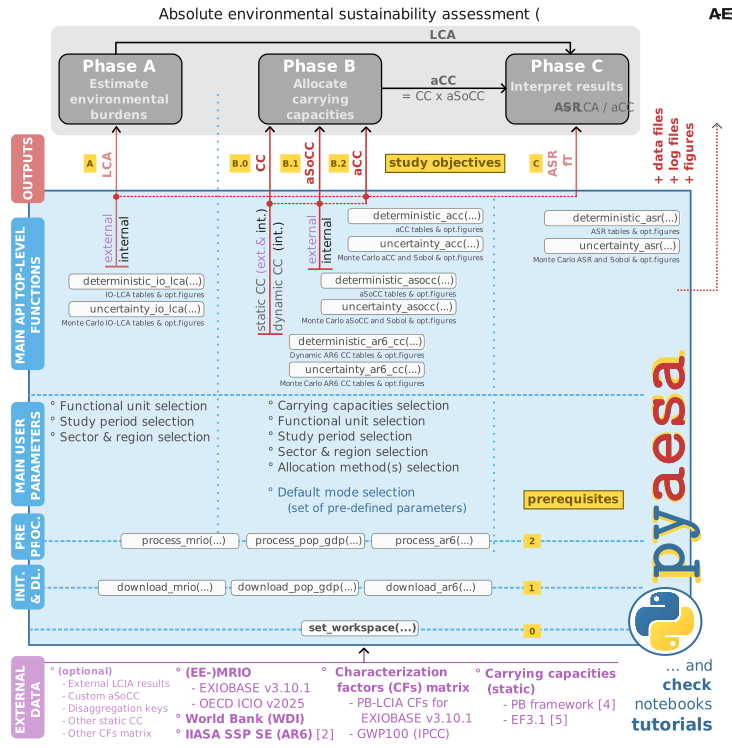
pyaesa supports AESA workflows from data preparation to deterministic and uncertainty results. The package follows three calculation phases:
Phase A computes life-cycle assessment results, including IO-LCA from processed MRIO data.
Phase B computes allocated carrying capacities, with
aCC = aSoCC * CC.Phase C computes absolute sustainability ratios, with
ASR = LCA / aCC.
Workflow Map
The figure below summarizes the main package data sources, public workflow functions, study objectives, and output families.
It is very important for the user to understand that to reach a desired study objective, pyaesa automatically runs upstream computations needed to produce the desired endpoint, i.e., to ensure that all previous outputs are available before running the downstream function providing the endpoint. This is illustrated via the green arrows (automatic nesting) in the figure below. Consequently, the user must focus solely on the desired study objective, and run the single relevant function.
Example Output Figures
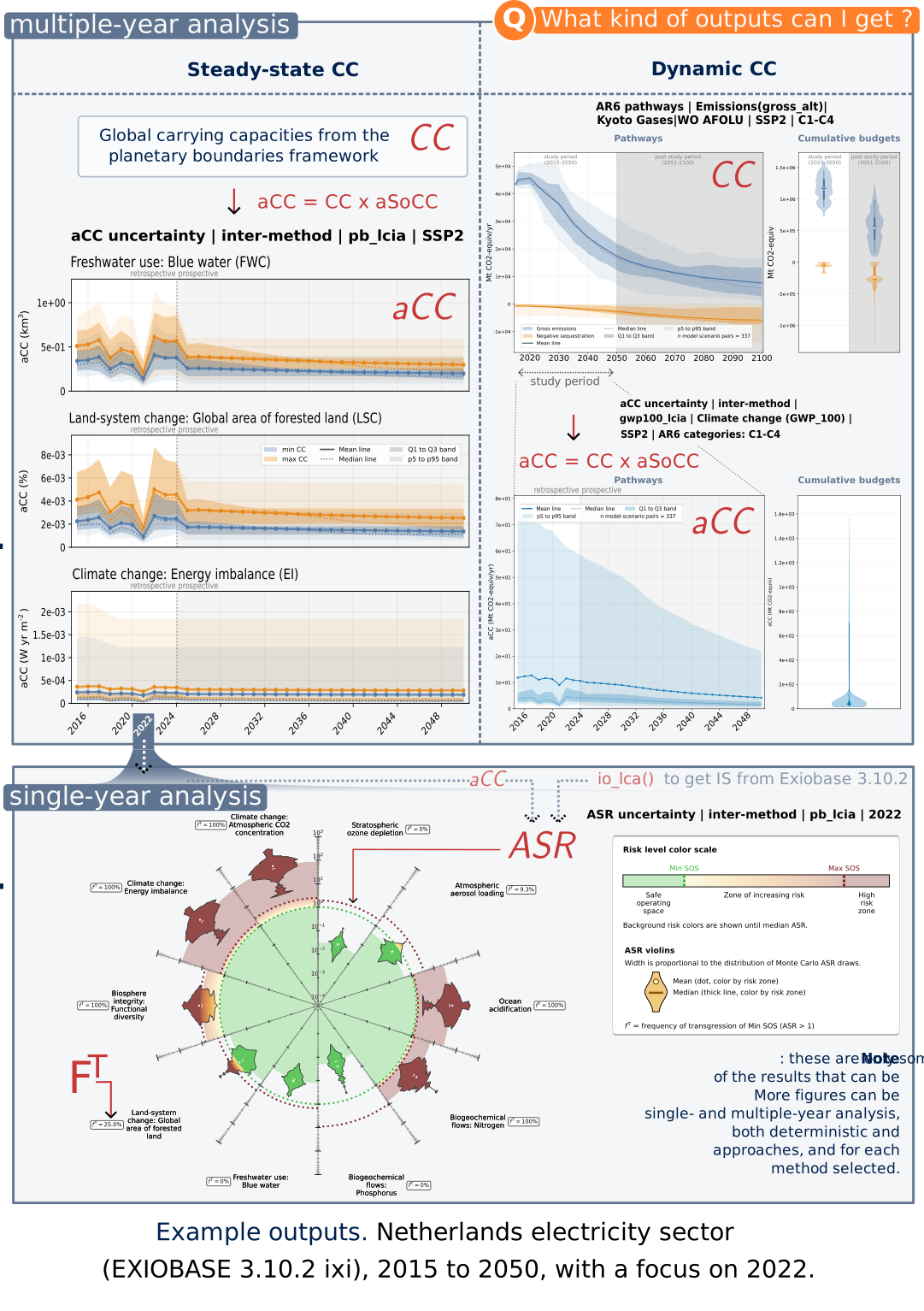
The example below illustrates some of the 83 figure families available with pyaesa. For steady-state carrying capacities, it shows allocated carrying capacity (aCC) trajectories and a single-year ASR polar figure. For dynamic climate change carrying capacities based on AR6 pathways, it shows global carrying capacity (CC) and allocated carrying capacity (aCC) trajectories and cumulative budgets.
License
pyaesa source code is distributed under the GPL 3.0 license. Downloaded datasets remain governed by their original providers’ terms and conditions documented in the Workflow Reference.
Copyright
pyaesa is a Python package for absolute environmental sustainability
assessment (AESA) workflows. It supports data download,
data processing, deterministic calculations, figure rendering,
Monte Carlo uncertainty and Sobol variance.

Copyright (C) 2026,
Université Paris-Saclay, Université catholique de Louvain,
Luxembourg Institute of Science and Technology, RWTH Aachen University.

This program is free software: you can redistribute it and/or modify
it under the terms of the GNU General Public License as published by
the Free Software Foundation, either version 3 of the License, or
(at your option) any later version.

This program is distributed in the hope that it will be useful,
but WITHOUT ANY WARRANTY; without even the implied warranty of
MERCHANTABILITY or FITNESS FOR A PARTICULAR PURPOSE.  See the
GNU General Public License for more details.

You should have received a copy of the GNU General Public License
along with this program.  If not, see <https://www.gnu.org/licenses/>.
Community
Contributing to pyaesa
pyaesa uses the GitHub Discussions Ideas category to collect feature ideas and development priorities from users.
Use Ideas to propose new features, request additional allocation methods, upvote existing proposals, and comment with your use case, data source, expected workflow, or implementation constraints.
To propose direct code modifications, for example implementing new allocation methods or other features, see CONTRIBUTING.md.
Installation
pyaesa requires Python 3.11 to 3.14 and at least 4 GB of available RAM.
python -m pip install pyaesa
The Workflow Reference provides the main data sources, workflow functions, and study objectives supported by pyaesa.