Functional Units And Allocation Methods For AESA Study Objectives
This note helps choose both the functional unit (fu_code) and the allocation
method selectors used by:
deterministic_asocc(...)anduncertainty_asocc(...)deterministic_acc(...)anduncertainty_acc(...)deterministic_asr(...)anduncertainty_asr(...)Only FU code:
deterministic_io_lca(...)anduncertainty_io_lca(...)
The functional unit (FU) and allocation method tables of this file summarize methodological_notes/methodological_note__asocc_fus_allocation_methods.pdf. That appendix provides the definitions and mathematical expressions for each allocation method available in pyaesa.
Functional units
Choose first the functional unit according to the case study goal, scope, and system boundaries.
The accepted code syntax is the dot format shown below, for example
fu_code="L2.c.b".
Symbols
Table 1. Sector and region selectors.
Symbol |
Definition |
|---|---|
|
Producing sector. |
|
Producing region. |
|
Final demand region where final demand occurs. |
|
Total demand region where the studied outputs are first sold, whether the first sale is to intermediate demand or final demand. |
The sector selector s_p is common to all level 2 (L2: sector level) FUs.
The region selectors (r_f, r_p, r_c) are specific per FU.
Table 2. Accounting boundary symbols.
Symbol |
Definition |
|---|---|
|
Final demand. |
|
Total demand, i.e. final demand + intermediate demand/B2B. |
|
Consumption-based accounting of final demand -> Scopes 1, 2, 3. |
|
Consumption-based accounting of total demand -> Scopes 1, 2, 3 |
|
Production-based accounting -> Scope 1 |
Functional unit table
Table 3. Functional units available by study objective.
|
Allocation level |
Study objective represented by the FU |
Accounting boundary |
Required selectors |
|---|---|---|---|---|
|
L1 |
Final demand of goods and services in region(s) |
|
|
|
L1 |
Total production of goods and services by producing region(s) |
|
|
|
L2 |
Total production of goods and services by sector |
|
|
|
L2 |
Total production of goods and services by sector |
|
|
|
L2 |
Total production of goods and services by sector |
|
|
|
L2 |
Total production of goods and services by sector |
|
|
|
L2 |
Total production of goods and services by sector |
|
|
|
L2 |
Final demand in region(s) |
|
|
|
L2 |
Total demand in region(s) |
|
|
Reading L2 FU codes:
Within L2, the middle letter describes how the sector and region scope is
defined:
Table 4. L2 FU code sector and region scopes.
FU family |
Scope represented |
|---|---|
|
Output of sector |
|
Output of sector |
|
Demand in a selected region for outputs of sector |
The last letter describes the accounting boundary:
Table 5. L2 FU code accounting boundary suffixes.
Suffix |
Boundary |
Use when the ASR numerator (LCA) measures |
|---|---|---|
|
|
Consumption-based accounting of outputs consumed by final demand (Scopes 1, 2, and 3). |
|
|
Consumption-based accounting of outputs consumed by total demand, i.e. final demand and intermediate demand/B2B (Scopes 1, 2, and 3). |
|
|
Production-based accounting of direct burdens in the producing sector-region pair (Scope 1). |
N.B., group_indices=True is not allowed for L2.a.b, L2.b.b, or L2.c.b
because summing total demand CBA output rows can double count. For these FUs,
define the upstream MRIO aggregation and disaggregation scope before running the study
with process_mrio(...) arguments: agg_reg, agg_sec, and agg_version.
Allocation methods
The definitions and mathematical expressions for each allocation method are provided in methodological_notes/methodological_note__asocc_fus_allocation_methods.pdf. The allocation method labels below use the syntax accepted by pyaesa.
Allocation paths overview
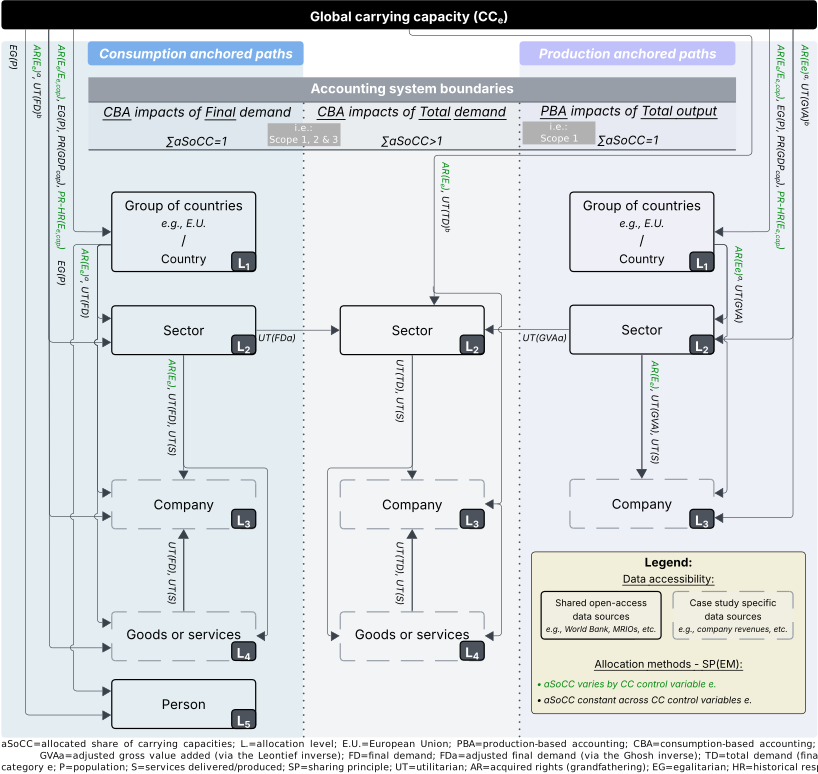
Figure 1: Overview of UNCASExt/pyaesa allocation paths and methods across allocation levels and accounting system boundaries. The figure summarizes the allocation routes and method labels available across levels and accounting system boundaries.
a UT(FDa) and UT(GVAa) are adjusted variants of UT(FD) and
UT(GVA) designed to reflect overlapping supply-chain attributions of utility.
b As the total direct and indirect GVA embodied in one unit of output
equals that unit’s value, i.e. its FD, the one-step allocation paths
UT(GVA) to UT(GVAa) and UT(FD) to UT(FDa) yield an identical result,
here named one-step UT(TD). This one-step total demand approach is therefore
neither consumption- nor production-anchored, analogously to one-step
AR(E^{CBA_TD}).
L3 and L4 are not yet covered by pyaesa directly and can only be covered by doing “manual” postprocessing of pyaesa outputs. L3 and L4 require case study specific data. Examples include company revenues to scale a sector-level allocation to a firm-level allocation by comparing company turnover to total sector output in the MRIO, or activity data (e.g., passenger-kilometers delivered) benchmarked against corresponding totals at the relevant MRIO level. A future update of pyaesa will include the possibility to address these levels via user provided L3 and L4 datasets.
Method label syntax
Table 6. Allocation method label abbreviations.
Abbreviation |
Meaning |
|---|---|
|
Sharing principle. |
|
Enacting metric. |
|
Utilitarian sharing principle. |
|
Egalitarian sharing principle. |
|
Prioritarian sharing principle. |
|
Historical responsibility. |
|
Acquired rights, also called grandfathering. |
|
Population. |
|
Gross domestic product per capita. |
|
Environmental pressure. |
|
Per capita environmental pressure. |
|
Cumulative value over the responsibility period. |
|
Final demand. |
|
Total demand, i.e. final demand + intermediate demand/B2B. |
|
Adjusted final demand, propagated through downstream supply chains with the Ghosh inverse. |
|
Gross value added. |
|
Adjusted gross value added, propagated through upstream supply chains with the Leontief inverse. |
Method selection arguments
Use method_plan="default" unless the study intentionally constrains the
method set and provides justifications to do so.
For L1 functional units, select subset of methods with l1_methods.
For L2 functional units, select subsets of one-step methods with one_step_methods,
two-step L2 methods with two_step_methods, and explicit L1 to L2 pairs of two-step methods with l1_l2_pairs.
Table 7. Accepted method_plan values.
Value |
Meaning |
|---|---|
|
Use all methods available for the selected FU. |
|
Use only selected one-step L2 methods. |
|
Use only selected two-step L2 methods combined with compatible L1 methods. |
|
Use only explicit |
|
Use selected one-step L2 methods plus explicit |
Explicit pair strings use the syntax L1METHOD::L2METHOD, for example
EG(Pop)::UT(FDa). The part before :: is the L1 method and the part after
:: is the L2 method. Method labels must match the registry labels exactly.
L1 allocation methods by FU
Table 8. L1 allocation methods available by FU.
|
L1 methods |
|---|---|
|
|
|
|
L2 allocation methods by FU
One-step methods allocate the L2 FU directly against the global carrying capacity.
Two-step methods first allocate an L1 share against the global
carrying capacity, then allocate the selected L2 FU inside that L1 share.
When the L2 in L1 weight is consumption-based, the L1 vs global weight
uses L1.a. When the L2 in L1 weight is production-based, the L1 vs global
weight uses L1.b.
Table 9. L2 allocation route equations.
Route |
Allocation structure |
|---|---|
one-step |
|
two-step |
|
Table 10. L2 allocation methods available by FU.
|
one-step L2 vs global methods |
L2 in L1 methods for two-step allocation |
L1 vs global FU used for two-step methods |
|---|---|---|---|
|
|
|
|
|
|
|
|
|
|
|
|
|
|
|
|
|
|
|
|
|
|
|
|
|
|
|
|
What to do next
Now that you have been through tutorials/study_objectives/0_study_objectives.md and tutorials/study_objectives/1_functional_units_and_allocation_methods.md, go to the tutorial corresponding to your study end objective. The available study objective notebooks are listed in tutorials/study_objectives/0_study_objectives.md.